
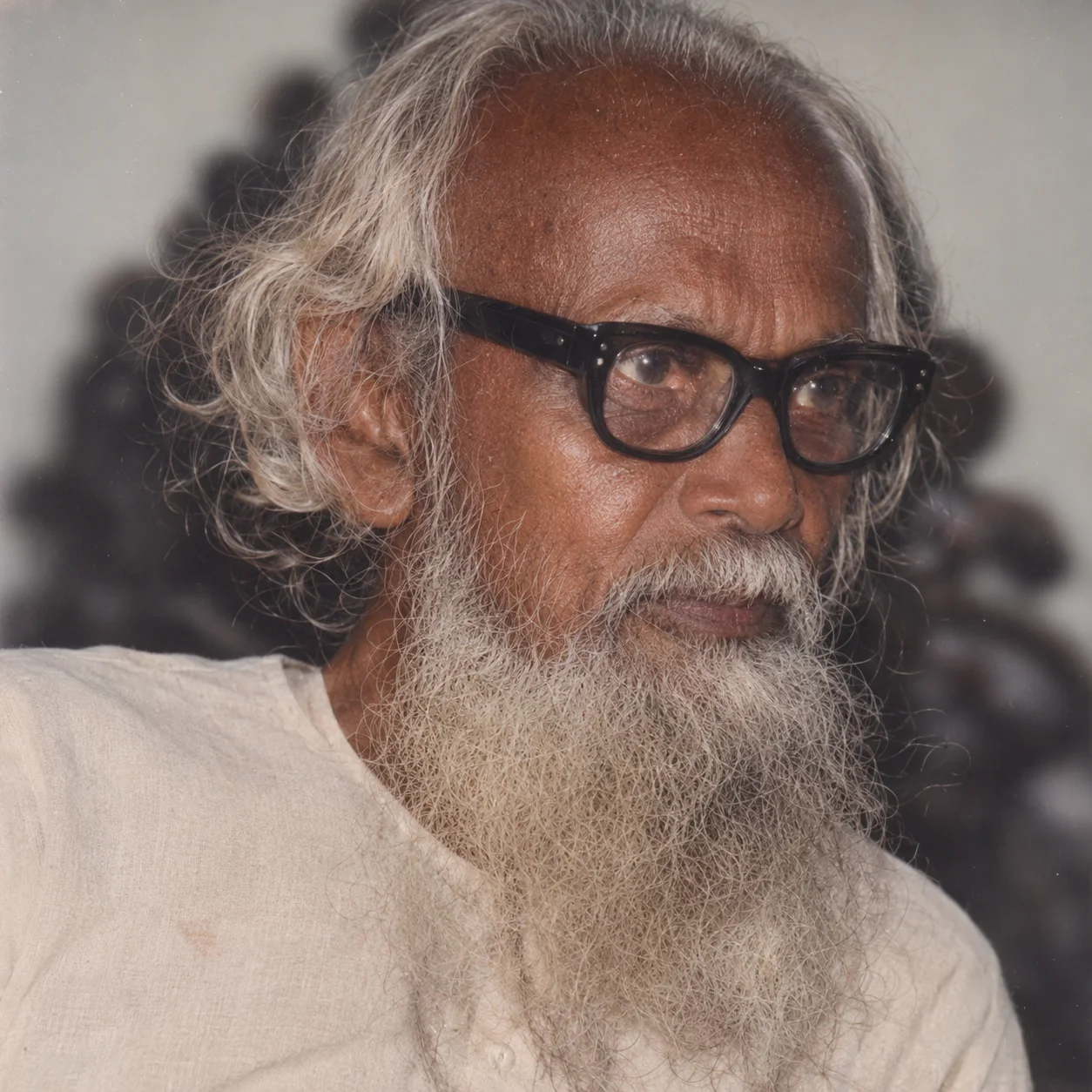
Mawla
Memories of Mawla
Recollections by two of Mawla's children, Faruk Ahmed Nazim and Sarwar Jahan Suraiya.
The recollections of two of Mawla's children, in their own words (English translation).
Faruk Ahmed Nazim
Mawla's eldest child
While he worked at the University of Dhaka, Papa walked to and from the office. On the way home he did the shopping, then cooked and ate with us himself. After a short rest he would go to the astana of Kashmiri Shah or the rawza of Kalachan Shah Baba, absorbed in discussion with companions: Kashmiri Shah, his khadem, Motaleb Shah Baba, Dulu Mastan, Hakim Baburchi and others. Hakim was called "baburchi" (cook), but was really a businessman; all of them were awliya and mastans. Kashmiri Shah's astana stood in deep jungle where wild animals lived, and they listened to songs there, sung by one Mongol Mia. If it got to ten or eleven at night at Kalachan Shah Baba's rawza, Amma sent me and my younger sister Suraiya with a lantern to look for him.
In the Faridabad house Papa had a very large, tall mosquito net. Inside it he stood in salat all night; sometimes he stayed awake all night reading the Qur'an, absorbed in meditation on Allah and the Rasul. If I woke late at night it looked as though Papa had fallen asleep over the open Qur'an on the table. When I quietly tried to close it, he would say, "Don't close it — I am not asleep."
When Papa's murshid, Khaja Shah Pir Chishti, came to the Faridabad house, Papa kept me home from school to sit in his service the whole time, ready for whatever he might need, even though his own khadem came with him. He also came to our ancestral home at Chunkutia, across the river, and stayed three or four days; then too Papa kept me and my cousin Tufan home from school to serve him. Relatives and neighbours came to see him and hear him speak, and waz gatherings were held for him.
When Papa went to Chunkutia I went with him. He stayed at the astana and I slept at our house nearby. At the astana he cooked khichuri in a very small pot — rice, lentils, salt, green chillies and leaves from a thick jute plant in the darbar. It looked like food for one person, yet besides the two of us, six or seven others all ate their fill. Papa served every plate with his own hand and never gave the spoon to anyone else. Food cooked by his hand was delicious and full of blessing.
Sarwar Jahan Suraiya
Mawla's second child
1. I am not used to writing, but I want to share a few things. Once I told my children that if they finished their lessons quickly I would give them chocolate. They did, but there was none in the house, and I forgot. Papa remembered. That afternoon he called me, took chocolates from his pocket and said, "Suraiya, you told the children they would get chocolate, and you forgot." He told me to give them out, and said: "When you promise children something, keep it; otherwise they stop trusting their mother." From then on I never forgot a promise, and my children came to trust completely that what their mother says is right. Though always absorbed in meditation and salat, he taught us, in our growing years, how to stay free of the faults that happened in front of him.
2. Trust in Mawla. From childhood I loved to stay close to Papa. He was mostly at one mosque or another, so whenever he came home I stayed near him, and my elder brother and I usually slept beside him. He told and taught us so much in those times that our character and outlook were shaped by his hand — different from the cousins we grew up with. He taught my brother and me to swim in the Buriganga, holding a hand under our stomachs and lifting us up whenever we began to sink.
3. When we lived at 1 Nabin Chandra Goswami Road, the women who carried water to houses started fighting in the street, pulling each other's hair. I opened the window to watch. Papa came down from upstairs and said behind me, "Close the window. Is a quarrel something to watch?" Ever since, I have walked away from quarrels; years later I understood how harmful watching them is.
4. My elder brother (Faruk Ahmed Nazim) and I went with Papa to bathe in the river. On the way we often saw sweepers cleaning the drain. Papa would make us wait, buy the sweepers something to eat, and clean the whole drain himself — all the way from Faridabad lane to the Buriganga. He never thought any work small; serving people was his first duty. He helped with housework and taught us how to do things: I learned to make pitha and to cut fish from him, and Amma said he taught her many daily tasks too, which is why all her work was so neat.
5. Papa was not always at home. He stayed at Subhadya for meditation, and later at Aminpara. When away he cooked khichuri for himself; anyone who ate his khichuri never forgot it.
6. When we lived at Nilkhet, Papa needed a chair, so he bought one and carried it home himself. Amma said a porter would have brought it for two taka. Papa replied, "If you want to give someone money, why make him work for it? Just give it. I can carry a chair myself." He never even asked for a glass of water; he fetched it himself.
7. Papa never made a show of himself, so we did not understand him; Amma told us. She said, "If you have any sorrow, tell your Papa and it will go away." I said I was shy to tell him. "Then say it in your heart," she said. Sitting before him and speaking silently, he would understand and answer. Once I was planning something I had told no one about, and Papa suddenly said it was better not to do it. He never spoke as an order — "this is good to do", "this brings a good result", "careful people do this" — but never words of command.
8. After independence, cloth arrived from Japan, and Amma bought a beautiful piece for our Eid clothes. When Papa admired it, she made him a lungi from it. He wore it once and never again; when she asked, he said, "A fakir asked for a lungi, so I gave him the new one." With the very first money she ever earned, twenty taka from teaching at a private school, Amma bought Papa an expensive pair of shoes; a few days later he wore them to the mosque, and after the prayer they were gone. Amma always wanted us well dressed, but Papa deliberately wore simple clothes, sometimes a panjabi with a big patch on the back, which he had us sew for him.
9. When we were very small, Papa bought a goat for Qurbani. We were happy, thinking of the meat, but after the sacrifice he gave all of it to the poor, keeping only enough for one meal for us. I saw him make an animal sacrifice only that once.
10. "Papa, I'm not asleep yet." At Nabin Chandra Goswami Road, Papa lived in the room at the top of the stairs. At night he stood in prayer inside his tall mosquito net. I liked to sleep beside him, and when I fell asleep he would carry me down to Amma's bed, which I did not want. One night I woke as he was carrying me out through the net and said, "Papa, I'm not asleep yet." He laughed, laid me back in his bed, and that night did not take me down.
11. The mosquito net. Because Papa prayed standing inside the net almost all night, Amma made a very tall one. I held the cloth taut under the sewing machine and thought I had sewn it too, though that was all I did. One part had a double layer that he used as a door to go in and out.
12. When we were small, Papa used to sing different songs by himself. I still remember some of them. …